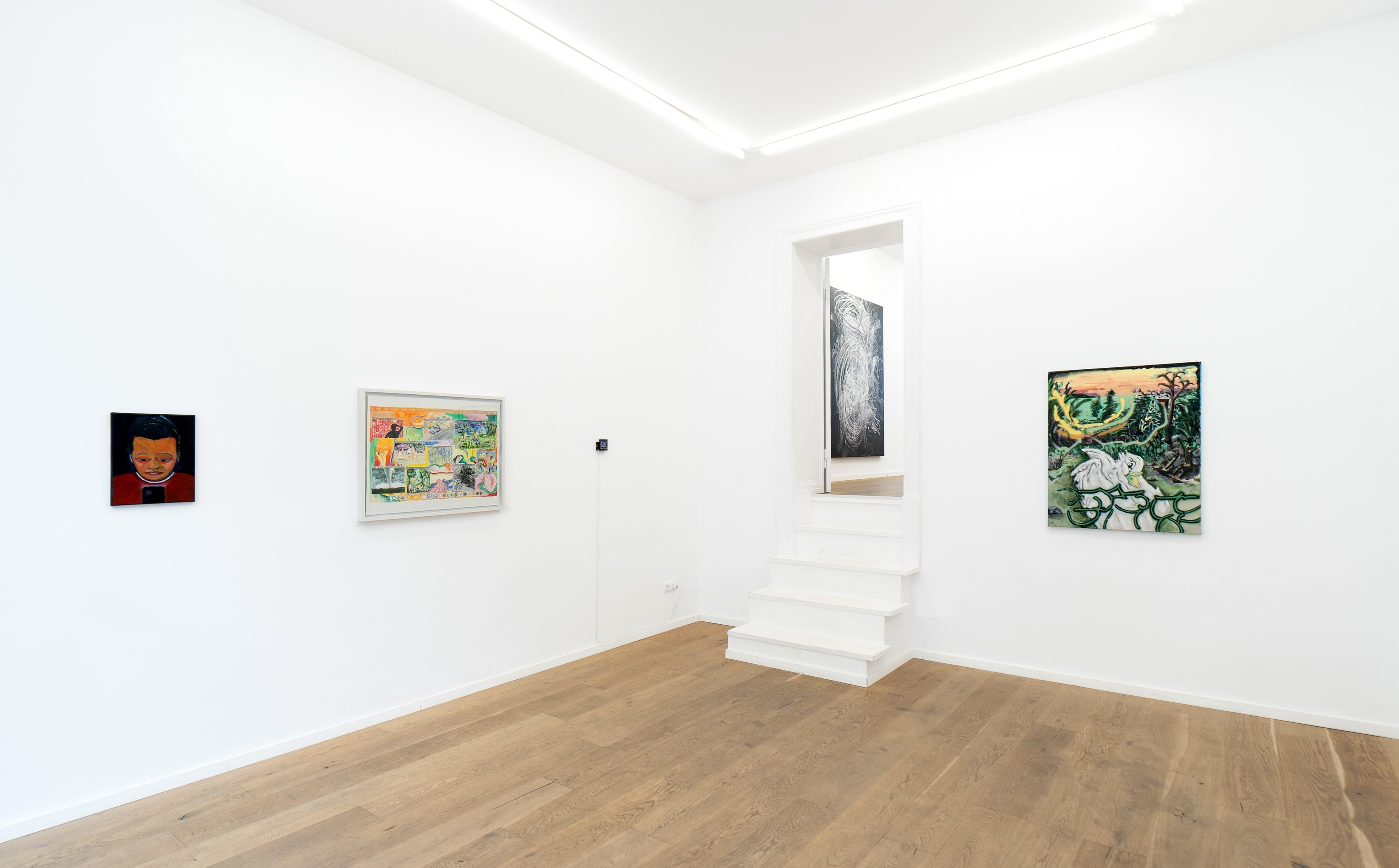
Exhibition View I
RJ (The Dark Room) → Yuran Yakon (Screentime V) →
nuv1924 (Auvers sur Olse) → Mical Noelson (Untitled) →
Martín Bruce (Pato)
Still Wet
Group Exhibition 15.08 - 04.09.2026
Curated by Kika Nicolela and Ruizhe Liang
Galerie Met (Berlin)
digital Release
objkt.com [special collection]
live at 14.08.2026 18:00 CET
Text by Kika Nicolela
There is a brief interval in the life of every painting during which the image has appeared,
yet has not entirely become itself. The paint is still wet. It reflects light unevenly.
It receives dust, fingerprints, accidental gestures; it resists certainty. During this
suspended moment the work remains vulnerable. Not because it is incomplete, but because it
is still capable of being altered by the world.
Painting has long measured time through drying. Pigment hardens. Varnish seals. To become a
painting has traditionally meant to pass from fluidity into permanence. From gesture into object.
Today, images seem to obey another temporality. They circulate before they settle; they are revised
after publication, re-rendered after exhibition, translated from canvas to screen, from screen back
into print, from print into photographs that circulate once again as images. Each stage renders the
image differently, and each rendering becomes the raw material for the next. Completion no longer
marks the end of an image’s life but one state within an ongoing chain of transformations. Maybe
the contemporary condition is this: images don’t ever really settle.
Perhaps this is what it means for an image to remain still wet. [...]
Exhibition View I
RJ (The Dark Room) → Yuran Yakon (Screentime V) →
nuv1924 (Auvers sur Olse) → Mical Noelson (Untitled) →
Martín Bruce (Pato)
[...] If the image no longer settles, where, exactly, does it live? The question of materiality
recurs across the conversations gathered with the exhibition’s artists, almost always as
a quiet rejection of the terms in which it is usually posed. Helio Santos again: “Digital
media require a great deal of physical infrastructure to exist: screens, printers, electrical
systems, servers, cables, processors. We often think of digital images as immaterial, but they
depend on very tangible conditions.” Yuran Yakon locates that materiality with unusual specificity,
through the very titles of his work. His GIF series Streams, he explains, plays on the fact that
“the word stream is offering an analogy between the stream of consciousness, the stream of water,
the stream of electricity and the stream of data” — the moving image, in his account, is not a
metaphor borrowed from water but a literal continuation of it, since, as he points out, “every
digital image is directly linked to processes of water consumption” through the cooling systems
that keep servers running. It is a strange and useful literalism for an exhibition called Still Wet:
the image that never quite dries, still wet because the machines that hold it are, too. [...]
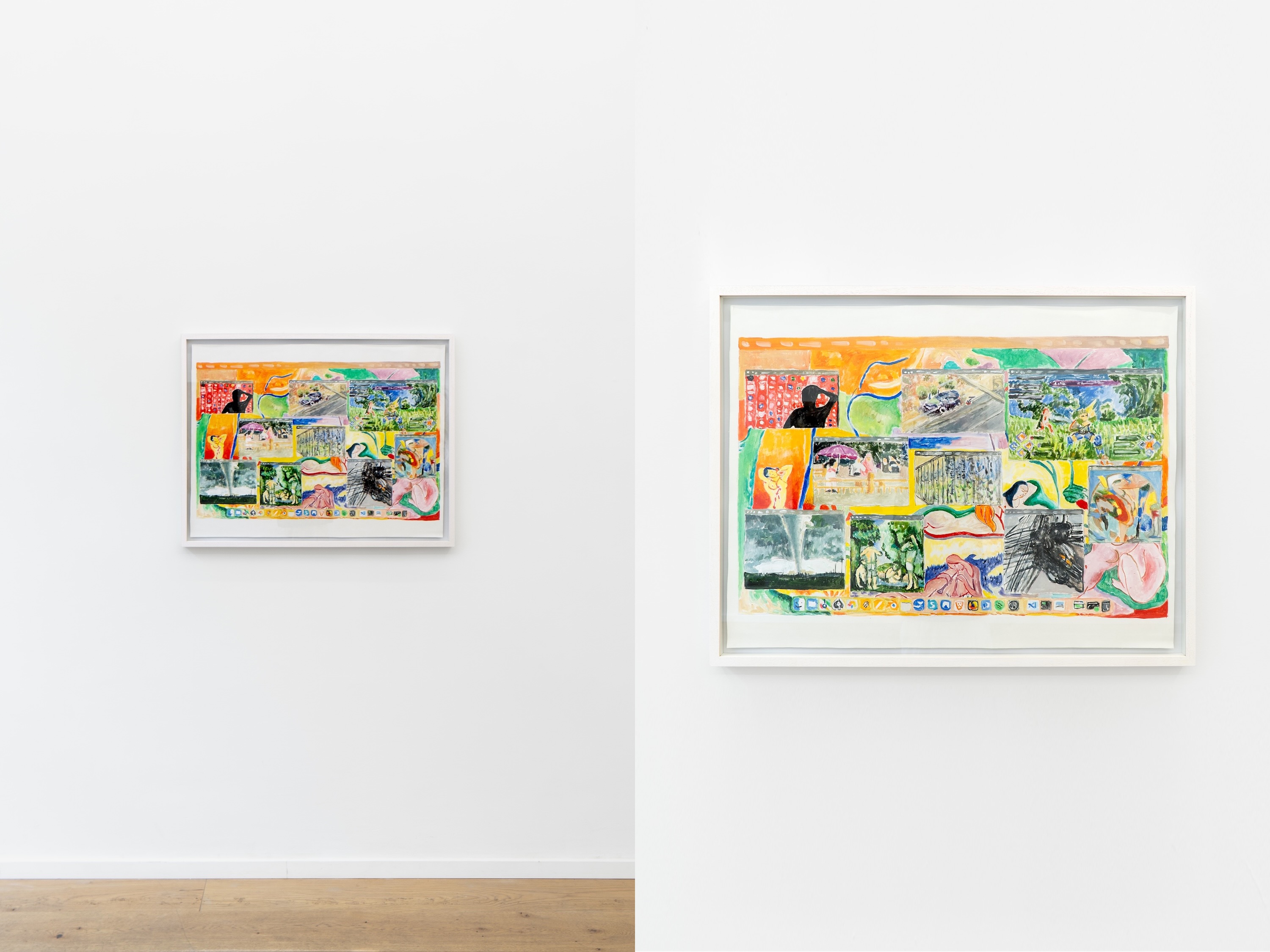
Screentime V
acryl on canvas
86 x 66 cm, 2024
[...] The question, then, is no longer whether painting survives the digital.
A more interesting question is whether “painting” is still the most useful
name for what these artists are doing — whether the word still names the thing,
or whether it is kept in use because no one is quite ready to let it go.
The artists themselves are divided, and their divisions are instructive.
Some reach for new words: “expanded painting,” “digital-image making,”
“a positioning between practices.” Zisis Bliatkas borrows a term coined by
another artist in the exhibition and calls what he does, simply, “Post Brush.”
Others refuse the entire vocabulary of periodization, on the grounds that any
label, however accurate, arrives already prepared to outlive its usefulness.
Perhaps it is enough, for now, to say the paint is still wet — and to notice that
this is no longer a claim about paint. It is a claim about images in general: that
they arrive without finishing, that a screen and a canvas can hold the same picture
at two different stages of the same unfinished process, that materiality has not
vanished but relocated, into servers, into hashes, into the small negotiated space
between one pixel and its neighbor. Painting, in the accounts gathered here, is not
the last holdout of an older, slower way of making pictures, patiently waiting to
be rescued or replaced. It is one of the ways — among the oldest, and evidently among
the most adaptable — through which anyone still thinks with images at all, on whatever
surface happens to be at hand.
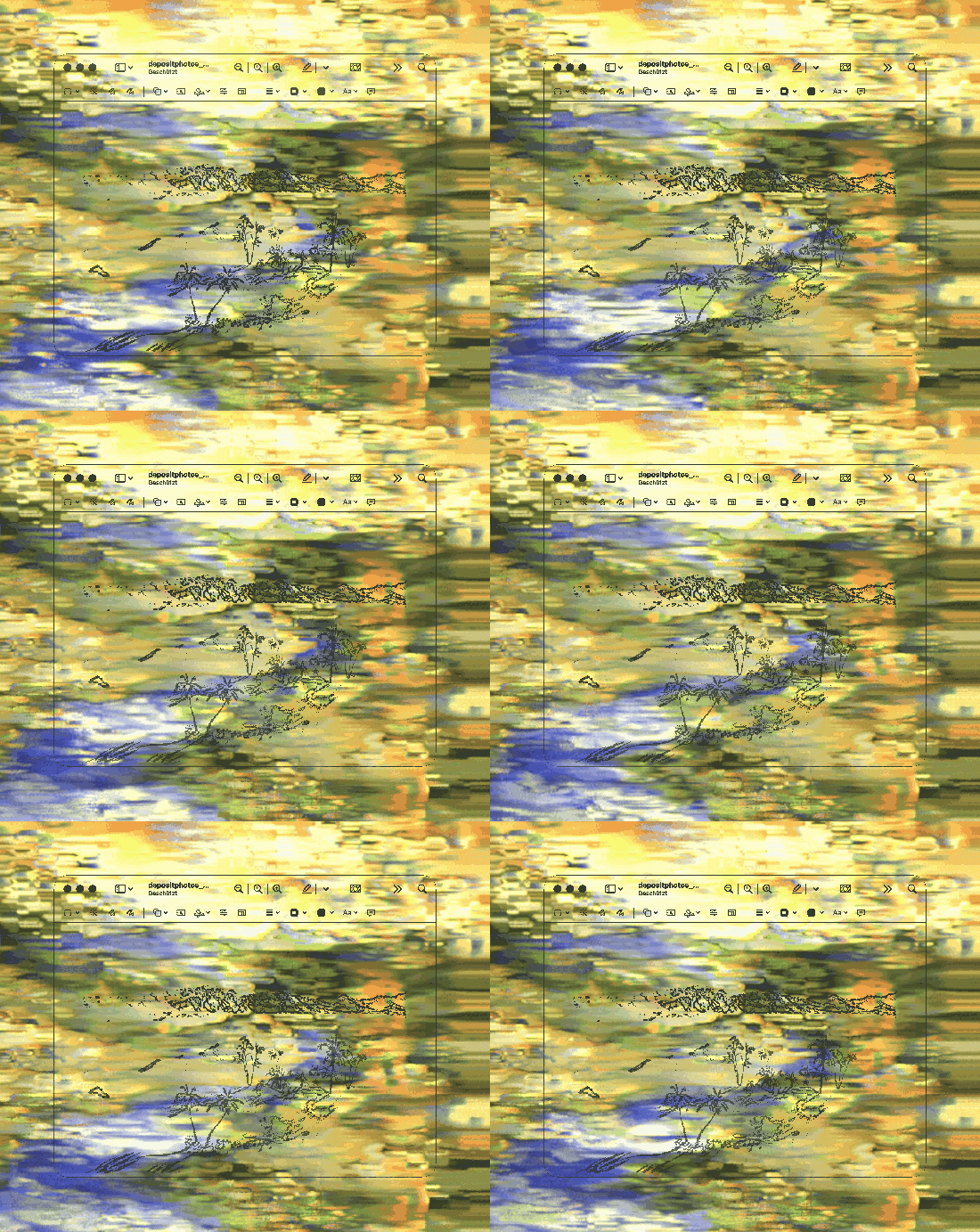
Liquid Silhouette: Desert Drain
GIF, 550 x 461 px, 2026
What this exhibition proposes, finally, is a suggestion about where images now live:
nowhere in particular, and therefore everywhere they are still being handled — poured,
layered, rendered, printed, minted, repainted, scanned again. The condition these eighteen
artists share has very little to do with the devices on their desks. They are witnesses
to the same fact, arrived at independently, in different languages, across four continents:
that finishing was never something an image did on its own. It was something we did to it,
standing in front of it, the moment we agreed to stop watching.
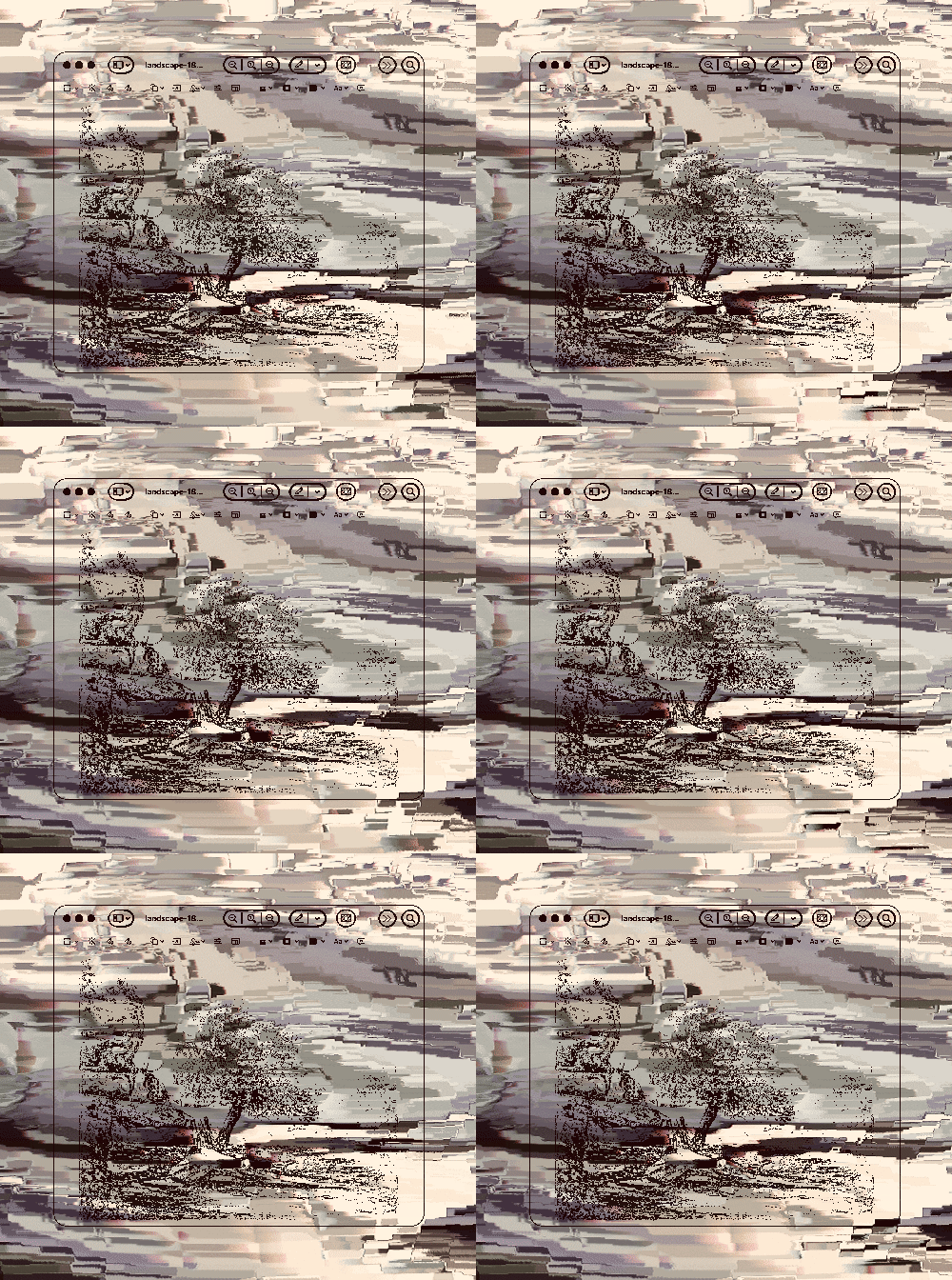
Liquid Silhouette: By the River
GIF, 500 x 448 px, 2026